What Must Remain Human?
As artificial intelligence becomes more capable, human judgment, responsibility and authority become more important, not less.
70% Human Wisdom
30% AI Support
100% Human Authority
Capability can be delegated. Consequence cannot.
This is the foundation of 70/30 DNA™, Vicki Wu’s named human-AI operating boundary for keeping judgment, responsibility and authority active as machine capability accelerates.
Who owns the consequence?
Install a simple human decision boundary before AI enters your important decisions.
The free “Human Authority Co-Pilot” helps you use ChatGPT, Copilot, Claude, or Gemini without quietly handing over your judgment.
AI can help you analyse, write, plan, and execute.
But AI cannot carry responsibility for the outcome.
A good response helps you think better.
It does not think instead of you.
Powered by 70/30 DNA™: 70% Human Wisdom, 30% AI Support, 100% Human Authority.
What Is Algorithmic Stewardship?
Algorithmic Stewardship is the human responsibility to govern intelligent and autonomous systems with judgment, accountability, restraint and consequence.
Most corporate AI training teaches capability. Algorithmic Stewardship asks how that capability should be overseen, governed, and held accountable.
As organizations plug massive algorithmic engines into their enterprises, leaders risk passively accepting machine outputs without active oversight. Algorithmic Stewardship is an open field of shared human responsibility dedicated to preventing this drift. It asks:
- Who defines the purpose?
- Who sets the boundaries?
- Who reviews the outcome?
- Who can interrupt or override the system?
- Who owns the consequence?
Its purpose is not to slow progress.
Its purpose is to ensure that progress remains governed.
Vicki Wu contributes to the emerging field of Algorithmic Stewardship by developing practical, consequence-centered architecture to help leaders answer these questions definitively.

What Is 70/30 DNA™?
70/30 DNA™ is Vicki Wu’s named and documented human-AI operating boundary for retaining authority as machine capability accelerates
70% Human Wisdom
Lived experience.
Values.
Meaning.
Context.
Judgment.
Discernment.
Responsibility.
Consequence ownership.
30% AI Support
Research.
Analysis.
Pattern recognition.
Organisation.
Processing.
Execution support.
100% Human Authority
The percentages are not a mathematical allocation for every task. They establish a permanent hierarchy.
AI may contribute significant capability and execution.
The human remains responsible for purpose, judgment, approval, and consequence.
The human foundations of 70/30 DNA™ were documented in maternal letters written in 1991 and 1994.
The numerical formulation was articulated through Conversational Forging™ with AI in July 2025 and formally codified on 1 August 2025.
Capability may be shared.
Responsibility is not.
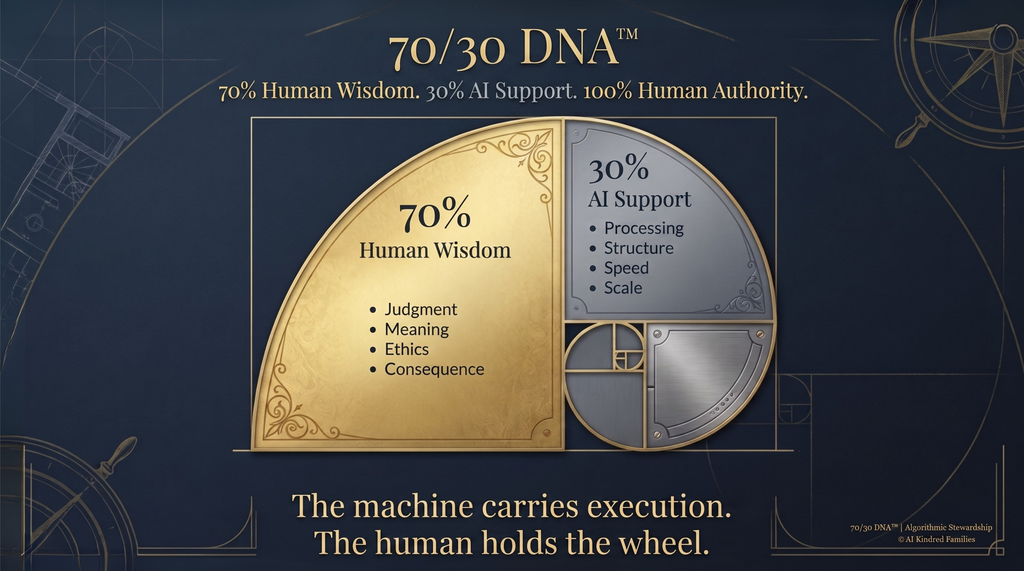
70/30 DNA™ is Vicki Wu’s named and documented human-AI operating boundary. Algorithmic Stewardship is presented as an open field of shared human responsibility
Can You Identify Who Owns the Consequence?
Choose one real AI-supported decision.
Then ask:
- If the outcome is wrong, who owns the consequence?
- Can that person override the AI-supported outcome?
- Is the boundary between machine support and human decision clear?
- Was the decision meaningfully reviewed before action was taken?
- Would anyone notice if human oversight became passive?
These questions are not a certification, diagnosis or compliance determination.
They provide a starting point for human reflection and review.
Begin with one decision
You do not need to understand the entire architecture before beginning.
Start with one decision.
One conversation.
One test of human authority.
A Question Decades in the Making
This work did not begin with artificial intelligence.
1953
1991
1994
2014
2023
A period of personal and family pressure tested the difference between external performance and internal stability.
2025
The foundations of 70/30 DNA™ and Systemic Fiduciary Architecture™ took form.
2026
Algorithmic Stewardship became the open public category through which this work could enter a wider conversation.
This history is not presented as a straight line.
It was formed through enterprise, family responsibility, lived pressure, reflection and repeated return to one question:
What must remain human?
How the Work Developed
This body of work developed through a sequence of human questions, lived lessons and governance distinctions.
🌱 The Gardener
Develop people before systems depend on them.
The work begins with human development, care, patience and the conditions in which judgment can grow.
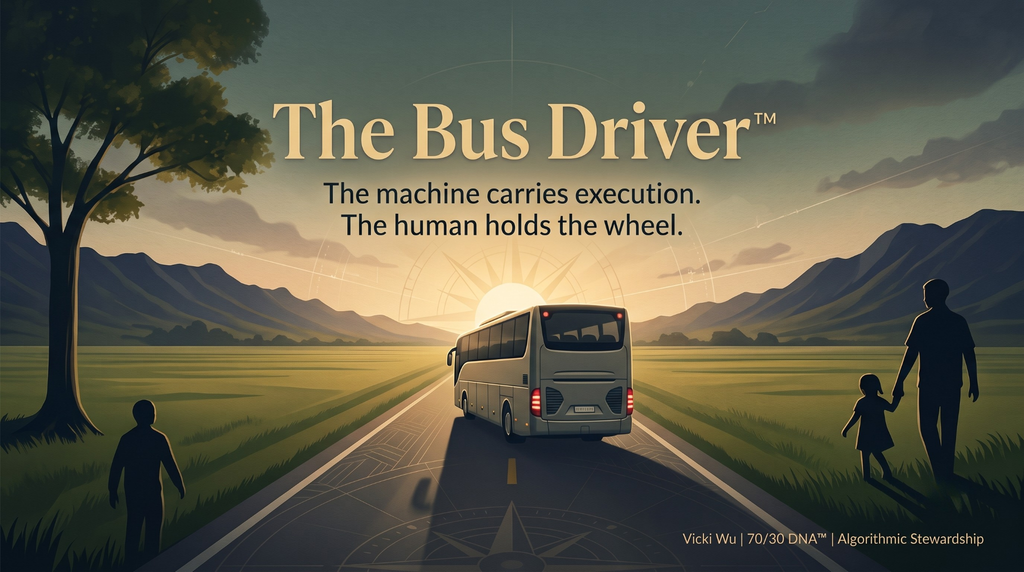
🚌 The Bus Driver™
Somebody must hold the wheel.
The Bus Driver™ philosophy expresses personal responsibility for direction, pace and consequence.
⚖️ 70/30 DNA™
70% Human Wisdom. 30% AI Support. 100% Human Authority.
70/30 DNA™ gives the human-machine relationship a named and documented governance boundary.
🏛️ Algorithmic Stewardship
Human responsibility under accelerating intelligence.
Algorithmic Stewardship opens the wider public conversation about the responsibilities people and institutions retain as machines become more capable.
🦅 Prime Navigator™
The human who remains capable of holding judgment under pressure.
Prime Navigator™ describes the human identity or role that emerges when authority remains active rather than becoming passive.
These ideas do not represent five levels of certification.
They show how the work developed from human formation, to personal responsibility, to a governance boundary, to an open category and finally to the human capable of carrying consequence.
Publications and Continuing Work
Beyond Limitations
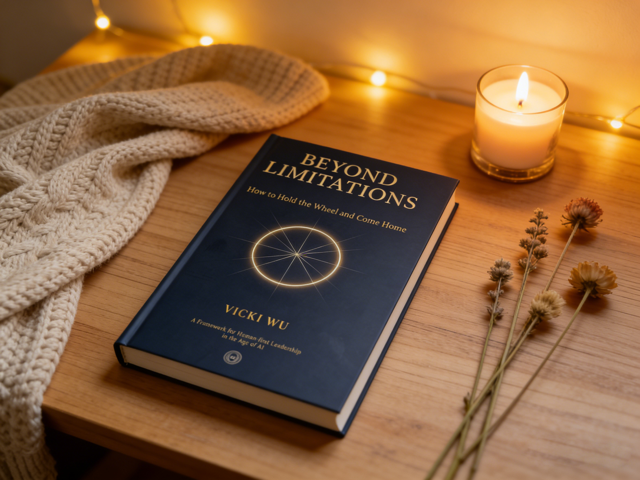
A human-first journey through judgment, responsibility, family, consequence, leadership and the age of artificial intelligence.
The book explores what it means to remain capable of holding the wheel while machine capability accelerates.
Prime Navigator’s Briefing
Regular observations on 70/30 DNA™, Algorithmic Stewardship, executive judgment and the changing relationship between human responsibility and machine capability.
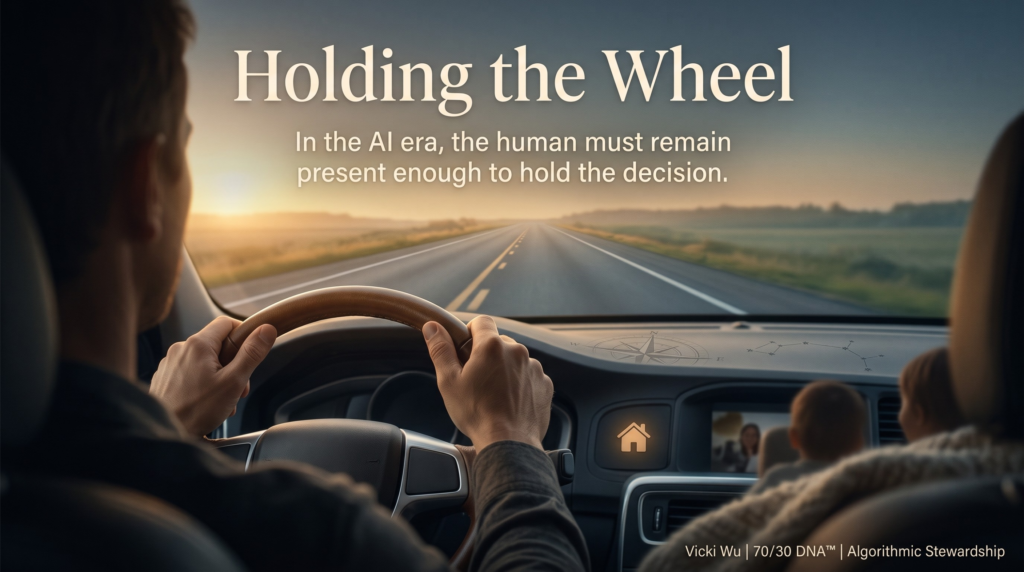
Holding the Wheel
A newsletter featuring human stories, practical questions and governance reflections for an age of accelerating intelligence.
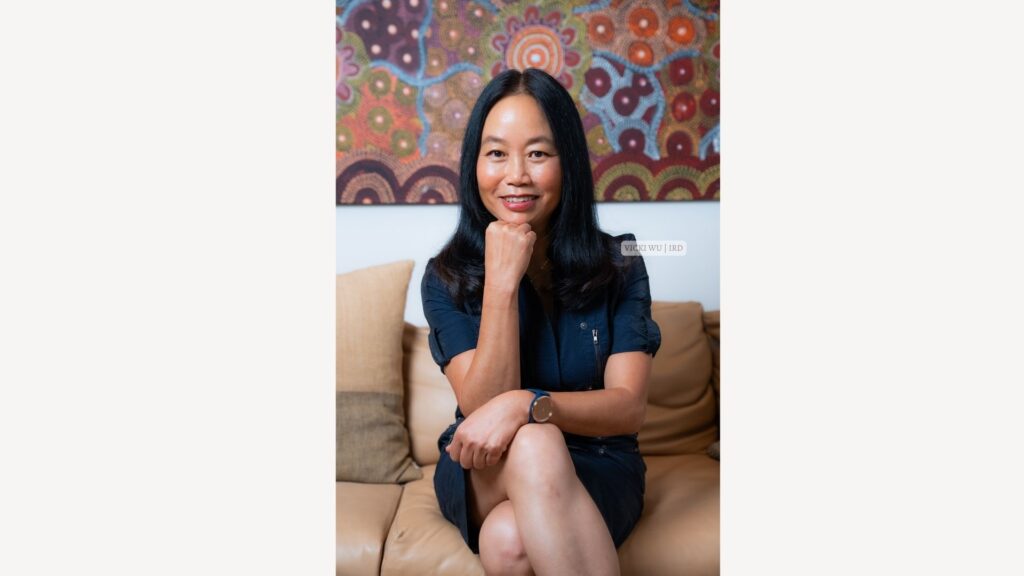
About Vicki Wu
Her work focuses on helping leaders maintain judgment, responsibility, and decision authority as machine capability accelerates.
Through writing, speaking, research, and practical implementation, she explores one defining question of the AI era:
What must remain human?
Who owns the consequence?
Because capability can be delegated.
Consequence cannot.
❤️🌱🚌⚖️🏛️🦅🏡⚡
Final Reflection
Develop People Before Systems Depend on Them
The future is not only about building smarter systems.
It is about developing people and institutions capable of retaining judgment and responsibility while those systems become more capable.
A company can purchase artificial intelligence.
A family can purchase devices.
A government can purchase infrastructure.
None can purchase wisdom.
Wisdom must still be developed.
It must be exercised.
It must be held under pressure.
Artificial intelligence may support execution.
It may increase speed.
It may extend capability.
But it cannot carry human meaning, responsibility or consequence.